
By Julia de Schultz, October 28, 2025 ~ 8 min read
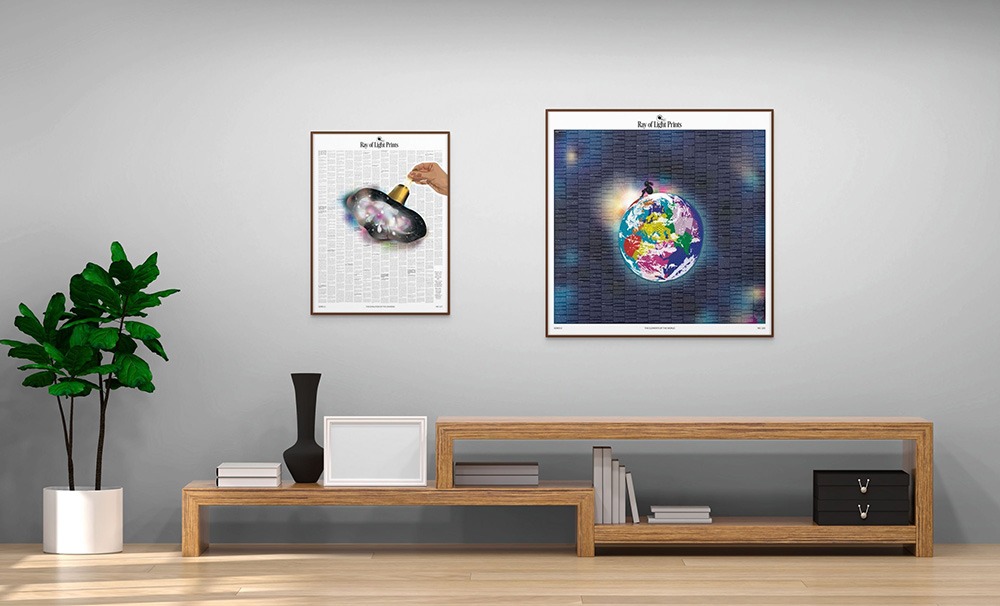
Have you ever stopped to notice the room you’re in right now? The colour of the walls, the images hanging (or not hanging) on them, the objects scattered around, the hum of background noise? We rarely pay attention to these things, yet they’re shaping us all the time.
Environmental psychology tells us that what surrounds us isn’t neutral. The spaces we live and work in are quietly programming our minds, influencing mood, focus, behaviour, and even long-term habits. Our walls aren’t just decoration. They’re powerful reminders that seep into our subconscious, nudging us toward (or away from) the life we want to live.
And it’s not only about walls. It’s everything we see, hear, and take in daily: the headlines we scroll past, the music or noise filling the background, the colours and symbols in our environment. All of it matters. All of it leaves an imprint.
In this article, we’ll explore the psychology of surroundings; why your walls matter more than you think, how everyday input feeds the subconscious, and how to design environments that truly support your best self.
The human brain is never switched off. Even when we think we’re not paying attention, we’re absorbing signals from our surroundings. A cluttered desk, a messy room, or a busy street doesn’t just exist outside of us; it changes how we feel and behave.
Psychologists call this priming. Subtle cues in our environment can alter our decisions without us even realising it. One famous study found that people exposed to words related to “old age” (like “wrinkles” or “Florida”) actually walked more slowly afterwards. Another experiment showed that shoppers moved faster or slower depending on the tempo of music playing in a store.
We like to believe we’re making rational, conscious choices, but often it’s the spaces around us making them for us. Environments are silent teachers. They either drain or replenish us, close us down or open us up.
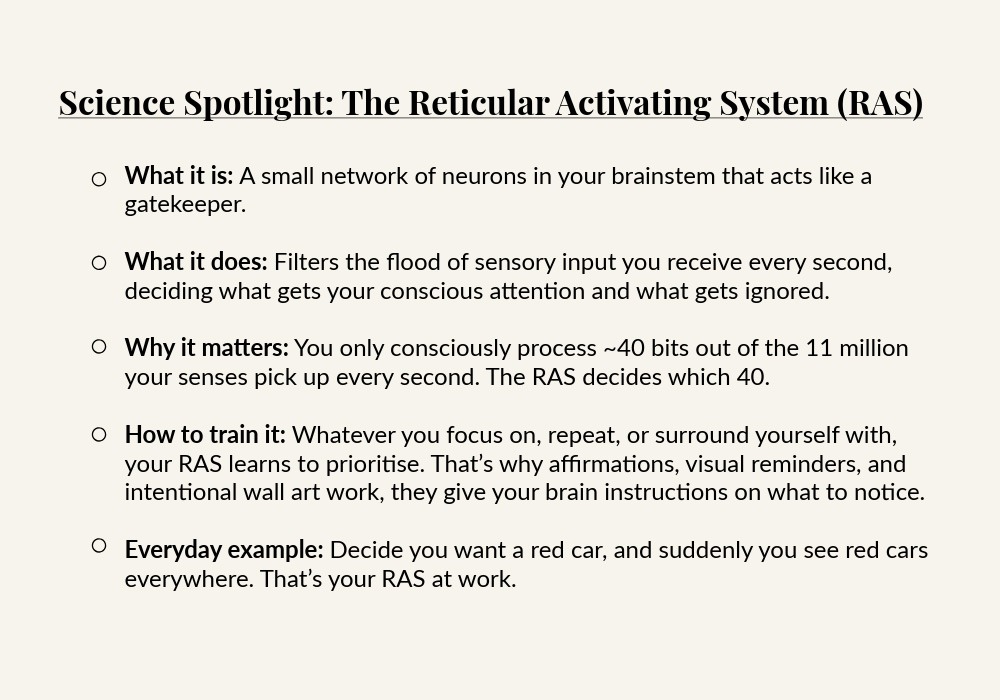
Your brain is a processing powerhouse. Every second, it receives 11 million bits of information through the senses: sight, sound, touch, smell, taste. Yet your conscious mind can only handle about 40–50 bits per second. That means almost everything you experience is filtered out before you’re even aware of it.
This filtering is essential; otherwise, you’d be overwhelmed. You don’t notice the feeling of your clothes on your skin after a few minutes, the constant hum of a fridge, or the endless background details in a room. Your brain decides what’s important and discards the rest.
The part of the brain doing this heavy lifting is called the Reticular Activating System (RAS). Think of it as your brain’s gatekeeper. It decides what gets through to your conscious awareness based on what it thinks is relevant.
Here’s the interesting part: you can train the RAS. Whatever you focus on, whatever you tell yourself, matters; the RAS begins to look for evidence of. That’s why when you decide you want a certain type of car, you suddenly see it everywhere. Or when you’re convinced the world is against you, you’ll find “proof” in daily events.
So when you say, “I am experiencing miracles today,” you’re not magically changing the world; you’re changing what your RAS notices. Your brain begins scanning for “miracle-like” moments, small acts of kindness, surprising synchronicities, or unexpected good news. It’s the same environment, but you’re tuned into different signals.
In other words, your environment is always feeding your subconscious, but your conscious focus trains your brain on what to filter in. This is why affirmations, intentional mantras, and visual reminders are so powerful. They’re not wishful thinking; they’re programming your RAS.
Walls might feel passive, but what you choose to put on them actively shapes your psychology. They’re not background, they’re foreground for the subconscious.
Research shows this again and again. Patients in hospitals recover faster when surrounded by calming art. Workers are more productive when nature scenes are present. Students engage more deeply in classrooms decorated with meaningful images. The brain is always scanning, and walls provide constant cues.
Colours play their role, too: blues and greens are calming, yellows can energise, while reds demand attention. Symbols also carry deep, universal weight: a tree, a spiral, a circle, each stirring meaning that bypasses words and goes straight into the subconscious.
Here’s where it gets even more interesting: once you understand how your RAS works, you realise walls aren’t just decoration, they’re training grounds for your focus.
Think of your walls as a visual script your subconscious reads daily. Every word, image, or symbol you repeatedly see becomes a cue for your RAS. Over time, it learns what to prioritise and starts scanning the world for more of the same.
This is something I notice in my own home. My daughter once wrote “I believe in you, mum” on a little Post-it and stuck it on my laptop. I still see it every day, and every day it primes me differently. It’s not just a note, it’s a filter for encouragement. The same goes for my Body Systems print hanging in our kitchen. It’s a constant reminder that my body is doing incredible things for me, and I should treat it with respect.
On the flip side, bare walls often feel sterile, and chaotic or meaningless visuals can leave you uninspired or unsettled. Without intentional cues, your subconscious has little to draw on.
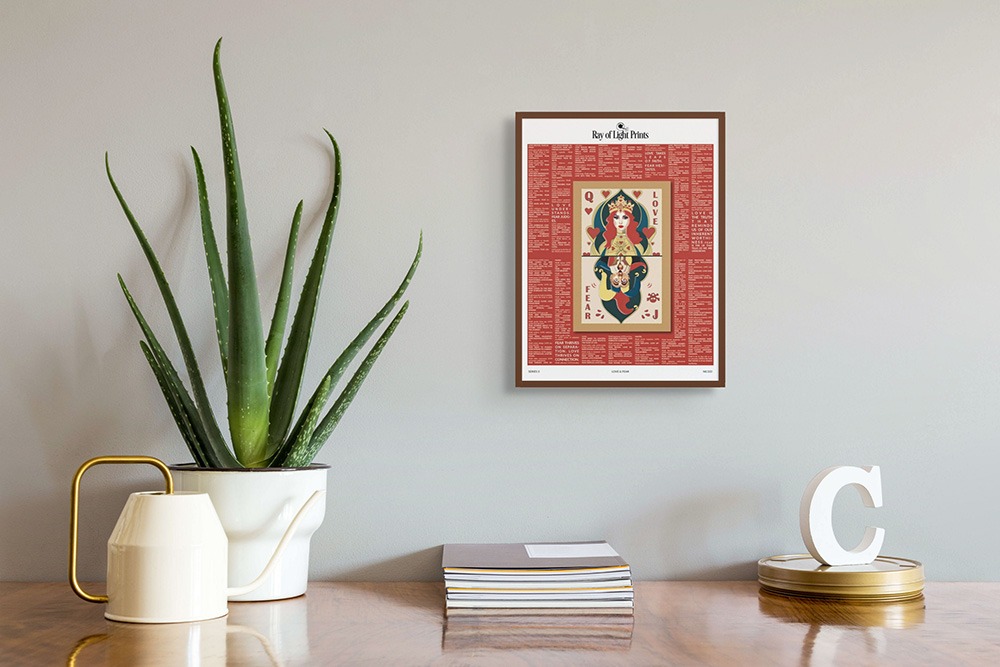
That’s why what you hang matters. Words, images, maps, knowledge, they all become anchors you return to daily, reminders of who you are, what you value, and what’s possible. This is one of the reasons I created Ray of Light Prints: to give walls the power to do more than fill space, to inspire, empower, and quietly nudge us toward growth.
And walls are just the beginning. Because what you surround yourself with doesn’t stop at home, your mind is constantly scanning everything you see in daily life.
The average person now sees an estimated 4,000–10,000 ads every single day. Most of them barely register consciously, but your subconscious records it all. Logos, colours, taglines, they slip in like background noise, shaping how you see yourself and the world.
Neuroscience shows that constant exposure to threat-based or negative imagery activates the amygdala, the brain’s alarm system. That’s why doomscrolling leaves us jittery and restless. In contrast, when we take in calming, inspiring visuals, the prefrontal cortex, the part of the brain that governs focus, reasoning, and calm, lights up instead.
This is why the “visual diet” matters so much. Ten minutes of scrolling through heavy news leaves a completely different imprint on your brain compared to ten minutes looking at a favourite artwork or even noticing patterns in nature.
Practical takeaway: Curate your visual input like you would your meals. Limit what drains you. Choose feeds and images that inspire. And every so often, give yourself a “visual fast”, step away from screens, walk outside, and let your brain recalibrate on beauty and simplicity.
It’s not just what we see, what we hear matters, too, more than most of us realise.
Soundscapes shape our physiology and emotions in powerful ways. Chronic exposure to city noise, for instance, has been linked to higher cortisol levels and increased cardiovascular risk. Even if you think you’ve tuned it out, your nervous system hasn’t.
Retailers have long used this to their advantage. Supermarkets play slow music to keep you browsing longer. Gyms blast high-energy beats to keep you moving. Even in cafés, a low hum of chatter has been shown to boost creativity, just enough stimulation without overwhelming.
On the flip side, nature sounds like birdsong or flowing water have been proven to calm the nervous system, lower blood pressure, and improve focus. Silence, too, is a soundscape in itself, one we rarely experience but one the brain deeply benefits from.
Practical takeaway: Pay attention to your daily sound environment. Curate playlists to match your energy needs. Add moments of silence where you can. And don’t underestimate the power of simple nature sounds: rain, waves, or wind through trees, to reset your mind.
Here’s the real key: our subconscious is always listening, always watching. Unlike the conscious mind, it doesn’t filter; it absorbs.
Studies suggest that as much as 95% of our daily behaviours, choices, and reactions are driven by subconscious programming. It’s the storehouse of every pattern, memory, and cue we’ve ever taken in. That’s why environments shape us so deeply, because most of the input never makes it to conscious awareness, yet it still directs how we act.
This is also why affirmations, mantras, and visual reminders work. Repetition gives the subconscious new instructions. Over time, those instructions become the autopilot scripts guiding behaviour. The same principle works in reverse: repeated negativity, headlines, self-talk, and toxic environments will also stick.
James Clear, author of Atomic Habits, puts it this way: “Environment is the invisible hand that shapes behaviour.” And the subconscious is where that hand does its work.
Practical takeaway: Treat your subconscious like fertile soil. Plant carefully. Place affirmations on mirrors, choose images that represent who you’re becoming, and use cues (like prints on your wall or wallpapers on your phone) to feed your mind what you want it to grow.

The good news is we’re not powerless here. We can design our surroundings to support who we want to be, and small changes can have huge ripple effects.
Psychology shows that “what is visible is what gets done.” For example, one study found that people ate more fruit simply by placing it on the counter instead of in the fridge. Visibility drives action.
Think about how this applies to your home or workspace. A print with a quote or image that anchors your values isn’t just nice to look at; it’s a cue. A visible reminder that nudges your subconscious to act in line with who you want to be.
Companies like Google have invested millions into this principle: their offices are filled with artwork, nap pods, and playful design features, all deliberately chosen to spark creativity and encourage collaboration. Your home doesn’t need a nap pod, but the principle is the same.
Practical takeaway: Do a simple “environment scan.” Walk through each room and ask: Does this space remind me of who I want to be? If not, adjust. Add art, remove clutter, curate what you see and hear daily. Your environment is either reinforcing your growth or quietly holding you back.
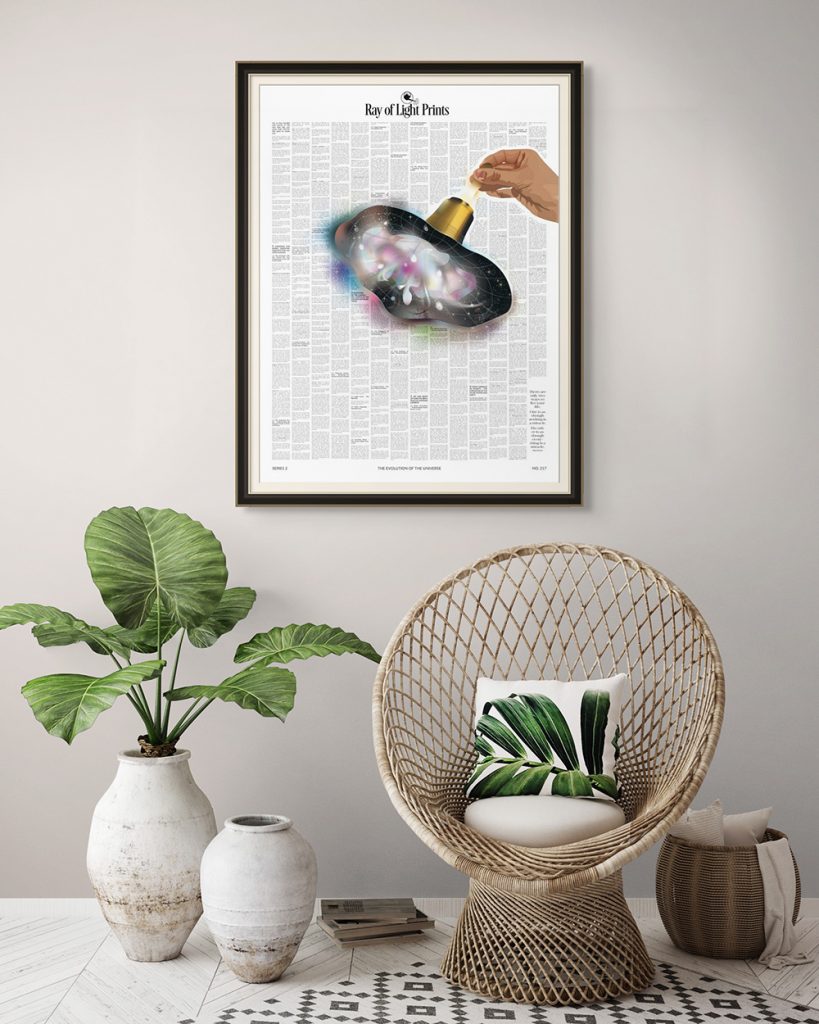
Beauty is often treated as an extra, something nice to have once everything else is handled. But I’ve come to believe beauty is essential.
Einstein once said that scientists often judge a theory by its beauty: if it was elegant, simple, and symmetrical, it was more likely to be true. Beauty is not luxury. It’s guidance. It’s nourishment.
When we surround ourselves with beauty, whether in nature, art, or knowledge distilled into form, we live differently. We breathe differently. We remember that we are part of something bigger.
That’s why what you put on your walls, what you listen to, and what you see daily matters so much. Beauty doesn’t just decorate life, it steers it.
Take a moment now. Look around you. What messages are your surroundings sending to your subconscious?
Are your walls silent, bare, or filled with reminders of stress and busyness? Or do they hold images and words that lift you, centre you, and remind you of who you want to be?
Life is full of noise, input, and endless distraction. But we get to choose, at least in the spaces we create for ourselves, what we surround ourselves with. And that choice matters more than we think.
Because walls are never neutral. Neither is the music, the words, or the visuals we live among. They are always shaping us. The question is: are they shaping you in the direction you want to grow?
If you’d like inspiration you can live with daily, take a look at our collection of prints, designed to bring knowledge, wisdom, and beauty into your space