
By Julia de Schultz, March 17, 2026

There are moments in life when peace doesn’t come from silence or stillness, but from clarity.
A health worry dissolves the moment a doctor explains what’s actually happening.
A fear softens the moment you understand its origin.
A heavy, confusing feeling becomes manageable the moment you have words for it.
Knowledge brings a kind of peace that is steady, grounded, and deeply human.
Not the aggressive “knowledge is power” slogan the world repeats…
but a gentler truth:
Knowledge is calming. Because when things make sense, it helps calm your nervous system.
Knowledge is grounding.
Knowledge is freedom from fear.
When we understand ourselves, our bodies, our emotions, our world — life doesn’t magically change.
We change.
Our nervous system relaxes.
Our breath deepens.
Our mind stops bracing for the worst.
This article explores why understanding leads to peace — scientifically, psychologically, and emotionally — and how the stories inside our Body Systems Print, Universe Print, and Elements Print act as daily anchors for deeper calm and inner steadiness.

Humans are designed to fear the unknown.
It’s not a weakness.
It’s biology.
For tens of thousands of years, the unknown signalled potential danger.
If you heard a sound in the bushes and didn’t know what it was, your body would prepare to run or fight.
If you encountered something unfamiliar, you assumed it could kill you, and this helped your ancestors survive.
Uncertainty is one of the fastest ways to activate stress; clarity helps calm your nervous system.
This ancient wiring still lives in us:
Your body isn’t being dramatic, it’s protecting you.
But in modern life, “unknowns” aren’t lion attacks anymore.
They look like:
Your nervous system responds the same way:
“What is this? Can I predict it? Can I control it?”
If the answer is no, your body prepares for danger, even when the danger is imaginary. Your brain doesn’t distinguish between reality and imagination. There’s a strong research case that uncertainty itself is a core driver of stress, not just what happens, but not knowing what might happen.
This is why, psychologically, clarity is calming:
When something makes sense, the brain stops scanning for threat.
Understanding tells your body: It’s okay. You can stand down.
This is the first doorway into peace.

There is something deeply soothing about understanding, especially when the thing we’re learning about is ourselves.
Most people go through life vaguely aware that their body is doing “stuff.”
But they don’t realise the scale, precision, or intelligence of it.
They don’t know:
When you learn this, something inside shifts.
Your fear of your body softens.
Your distrust becomes admiration.
Your anxiety loosens because you see, in detail, how supported you actually are.
This is why our Body Systems print lands so deeply with people.
It’s not just educational.
It’s disarming in the best possible way.
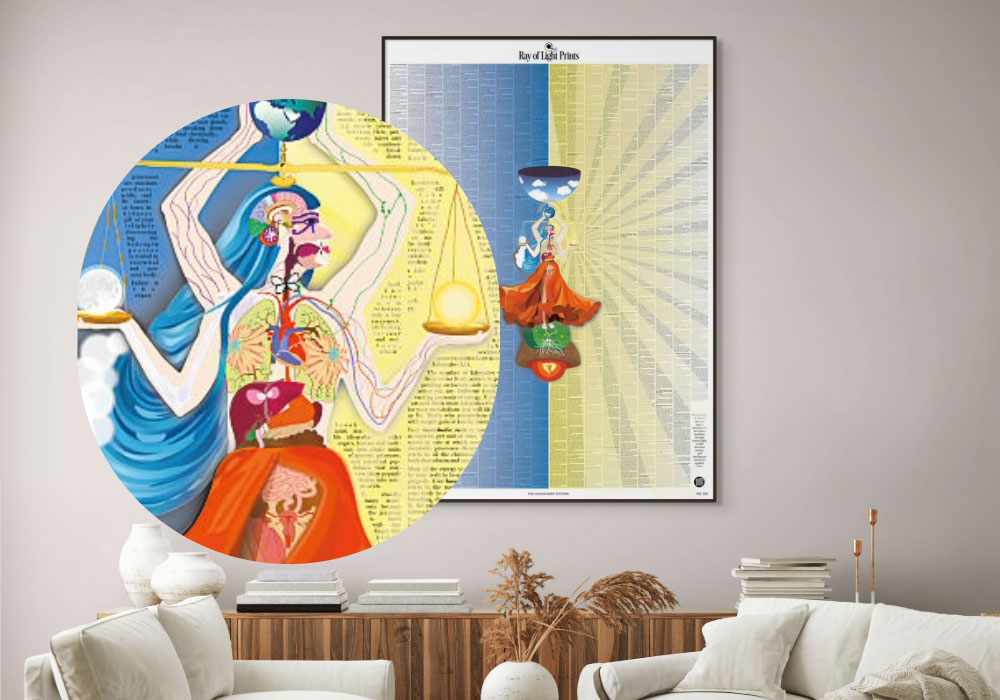
Someone who once panicked over every sensation suddenly understands:
“Oh. My digestive system is doing its job.”
“That tight feeling is just my stress response.”
“My immune system is working, not failing.”
“My heart knows exactly what it’s doing.”
Knowledge turns the body from a mystery into a partner.
And partnership brings peace.
When people understand their body, gratitude naturally follows, and gratitude is one of the most stabilising emotions the nervous system knows.

One of the fastest ways to soothe worry is to zoom out.
Not spiritually — biologically. Of course, spirituality also helps, but here I am talking about biology.
Research shows that awe (the emotion of encountering something vast or meaningful) reduces stress, lowers inflammation, slows the heart rate, and quiets the mind.
Awe does this by taking us out of our narrow perspective:
our schedule, our fear, our imagined futures, our spiral.
Cosmic perspective, seeing your place in the universe, is one of the most powerful forms of awe humans can experience.
Your Universe print offers exactly that.
It shows the sequence of events that had to occur for you to exist:
When you truly understand this, your overwhelm shifts.
Not because your problems disappear, but because they’re placed inside a wider frame.
Your stressful email is real.
Your fear of the future is real.
Your responsibilities are real.
But they are not the whole story.
The universe widens your view.
It shows you:
“You belong to something ancient.
You come from something vast.
You are part of something ongoing.”
Perspective doesn’t invalidate your struggle.
It softens its grip.
One of the most healing discoveries in psychology is this:
Gratitude isn’t something you force — it’s something you feel naturally when you understand.
Understanding creates gratitude without effort. In controlled studies, simple gratitude practices have been associated with improved well-being over time.

This is where our Elements print transforms the everyday world.
Most people look around their home and see objects:
a table, a phone, a ring, a lamp.
But when they understand the elements that make up those objects — copper, carbon, silicon, gold, oxygen — the story changes.
These aren’t just things.
They are materials borrowed from Earth.
They are the result of millions of years of geological, chemical, and cosmic processes.
Gratitude becomes almost inevitable.
The phone becomes a marvel of minerals.
The ring becomes a piece of a star.
A glass of water becomes the most ancient substance on Earth.
And with that gratitude comes responsibility.
Care.
A softer kind of environmental awareness, not driven by fear or shame, but by appreciation.
Understanding makes us want to protect what we belong to.
This is how knowledge leads to peace, not through ignorance of the world’s problems, but through reverence.
There is a moment, subtle but profound, when someone shifts from self-judgment to self-understanding.
And in that moment, their entire emotional experience changes.
Understanding your inner world is one of the most effective ways to regulate your outer world because:
Peace doesn’t come from removing discomfort.
It comes from understanding it.
For example:
When you learn the biology of stress, you realise
your racing heart, your tight chest, your rapid thoughts aren’t failures.
They are your body trying to protect you.
When you learn about the nervous system, you understand why you shut down, freeze, or overreact.
None of it means you’re weak, it means you’re human.
When you learn about emotions, you understand that sadness isn’t brokenness, it’s a message.
Anger isn’t aggression; it’s a boundary.
Fear isn’t weakness; it’s alertness.
Understanding turns self-blame into compassion.
Compassion turns fear into calm.
Our Body Systems print often starts this conversation for people.
They stand in front of it and suddenly see:
“My body is not the enemy.
It’s been working for me all along.”
That is peace.
Misunderstanding is the root of most conflict.
Assumptions create distance.
Lack of context creates defensiveness.
Not understanding someone’s history creates hurt.
But the moment we understand, truly understand, another person’s behaviour, something in us softens.
Not excusing harm.
Not tolerating disrespect.
But recognising the roots of behaviour.
Understanding creates empathy.
Empathy reduces emotional charge.
Reduced emotional charge increases peace.
Psychologically, this is known as reappraisal, when you reinterpret a situation, your nervous system calms.
For example:
Understanding others is one of the most underrated paths to inner peace.
Knowledge doesn’t just help us analyse.
It helps us connect.
There is an ancient idea, found in Greek philosophy, Hindu scriptures, Buddhist teachings, and indigenous knowledge systems, that learning is not “adding” something to the mind.
It is remembering what was already there.
It is awakening something dormant.
It is returning to something familiar.
This is why understanding feels calming.
It resonates.
It aligns.
It feels like truth.
I wrote a whole article about this: Remembering What We Already Know: The Ancient Idea That Learning Is Awakening
When people look at our prints, whether the cosmic journey of the Universe piece, the biology of the Body Systems, or the elemental composition of the world, they often say variations of the same thing:
“It just makes sense.”
“I feel grounded.”
“I feel connected.”
That connection is not new.
It’s remembered.

Not all information brings peace immediately.
Sometimes knowledge destabilises before it soothes.
Learning about climate change, for example, can be heavy.
But understanding the elements in everything you touch (as outlined in our Elements print) can transform fear into care.
Learning about your body can trigger worry.
But continuing to learn transforms worry into empowerment.
Learning about the complexity of the universe can feel overwhelming.
But sitting with the full story, not just the facts, transforms overwhelm into awe.
Knowledge isn’t always calming at first.
But it becomes calming when integrated.
This is why wisdom is not fast.
It’s slow.
Absorbed.
Lived.
Returned to again and again.
Our prints act as daily integration spaces, turning information into familiarity and familiarity into groundedness.
Peace isn’t an event.
It’s a practice.
Just like the body, the mind needs signals of safety.
Knowledge gives those signals.
You can weave understanding into your life in small, nourishing ways:
1. Learn one grounding thing each day
Not to be productive, but to feel connected.
A scientific fact.
A piece of history.
A philosophical idea.
A reminder of how capable your body is.
2. Notice your body’s intelligence
When your heart speeds up, instead of panicking, recognise:
“My body is protecting me.”
That simple understanding changes everything.
3. Replace self-judgment with curiosity
“What is wrong with me?” →
“What is this part of me trying to say?”
4. Zoom out regularly
Look at the stars.
Look at your Universe print.
Remember how unlikely and extraordinary it is that you’re here.

5. See the world materially
Look at your cup.
Your phone.
Your jewellery.
Your furniture.
Recognise the elements inside them.
Feel the gratitude deepen.
6. Surround yourself with reminders
Your environment shapes your nervous system.
Prints that expand perspective create micro-moments of calm throughout the day.
Knowledge isn’t theoretical.
It’s embodied.
It affects your breath.
Your posture.
Your emotional tone.
Your decisions.
Understanding is one of the most powerful mental health tools available to us, which calms your nervous system and yet it costs nothing.
The world doesn’t become peaceful when problems disappear.
It becomes peaceful when they make sense.
When we understand our bodies, we stop fearing them.
When we understand our emotions, we stop fighting them.
When we understand the people around us, we soften.
When we understand the universe, we feel held.
When we understand the elements, we feel connected to Earth.
Knowledge doesn’t remove life’s challenges.
But it changes how we carry them.
It widens your perspective.
It shifts your nervous system.
It opens your heart.
It grounds your mind.
It roots you in something bigger, wiser, older.
The more you understand, the more peaceful you become.
May what you come to understand, in your body, in the world, in this universe, become a quiet place for your mind to rest.