
By Julia de Schultz, August 5, 2025
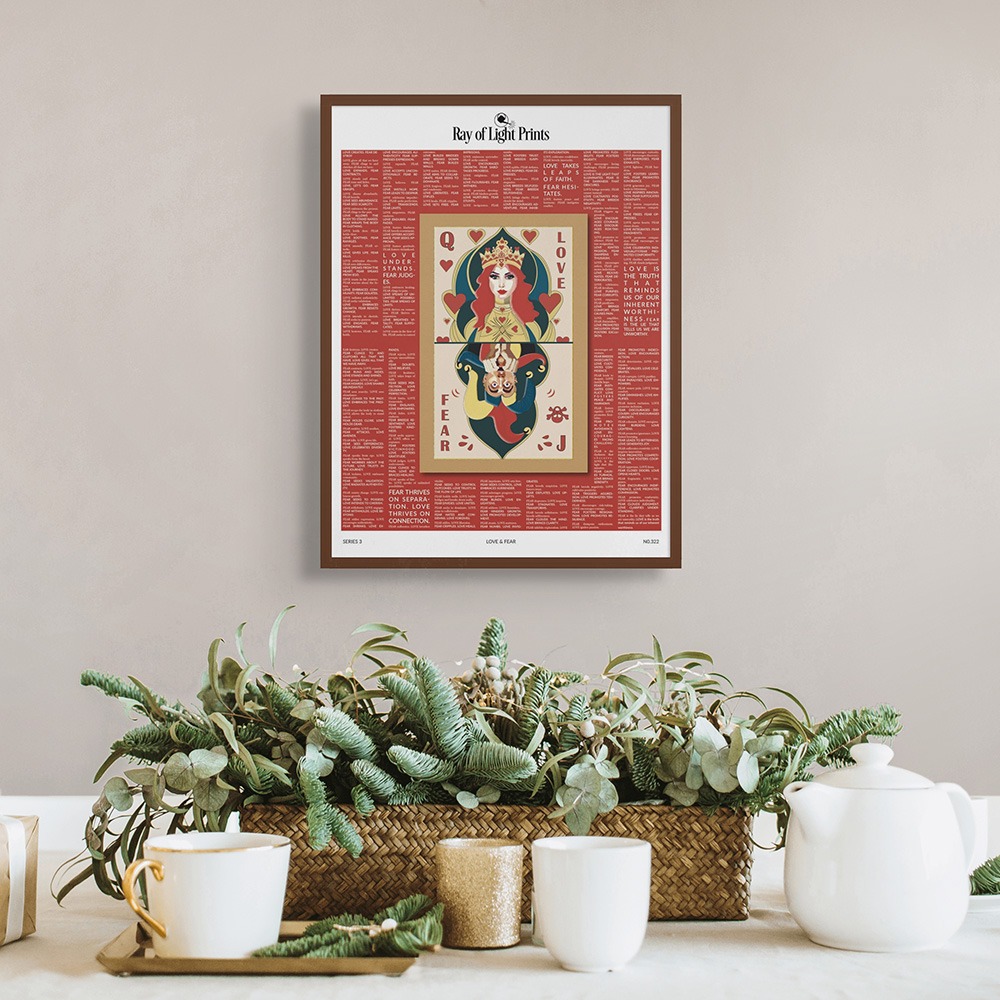
There’s a quiet truth I’ve come to believe more and more deeply, especially since founding Ray of Light Prints: beauty in science isn’t a luxury. It’s a compass.
When we think of science, most people picture data, equations, labs, and logic. But talk to any great scientist, Einstein, Dirac, Feynman, and they’ll tell you something unexpected. That beauty in science isn’t decoration. It’s guidance. And often, it’s a clue that we’re on the right path.
In physics and mathematics, theories that are considered beautiful are often the enduring ones. Elegance, symmetry, and simplicity are not merely issues of beauty. They are part of how scientists evaluate whether an idea is likely to be true.
Einstein’s theory of general relativity, for example, was not revolutionary simply because it worked. It was admired for its simplicity. It reduced complex phenomena to a beautiful explanation of space and time.
Paul Dirac, who helped develop quantum mechanics, famously said, “It is more important to have beauty in one’s equations than to have them fit experiment.” That may sound counterintuitive, but throughout history, beauty has often served as a signpost to truth.
When I started Ray of Light Prints, I didn’t come from a traditional art background. What led me here was a deep curiosity, a love of learning, and a fascination with how the world works. I wanted to create something that honoured that wonder.
The deeper I went, the more I noticed a pattern. The profoundest truths were also the most beautiful, not just in logic but in form. And I wanted to bring that beauty forward, to show it, not just explain it.
Our prints are made to do exactly that. Whether it’s the evolution of the universe, the inner workings of the body, or the structure of the periodic table, we design them to make you stop and feel something. Something like awe. Because science is full of it.
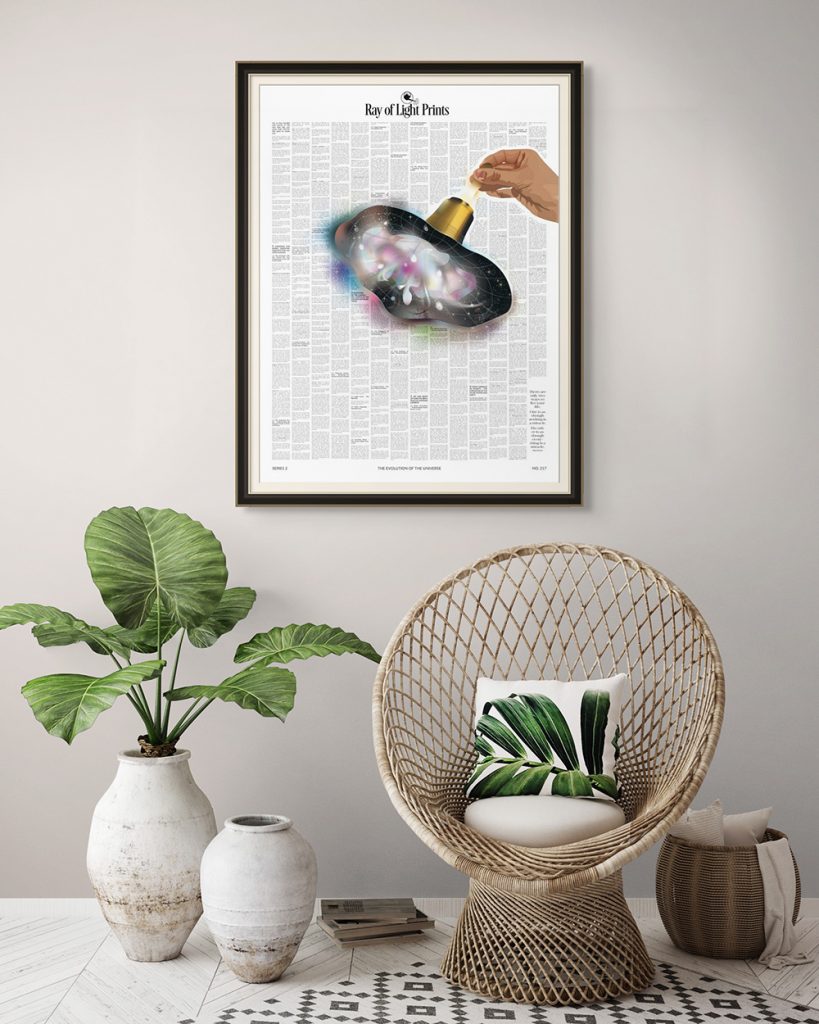
Designing a print like The Evolution of the Universe wasn’t just a layout exercise. It was a storytelling challenge. How do you visually represent billions of years of cosmic history without overwhelming the viewer or flattening the wonder?
The answer came through a visual metaphor. We used a spiral to represent time unfolding, a shape that echoes through galaxies, flowers, weather systems, and shells. The image became more than a timeline. It became a reminder of the patterns that connect everything.
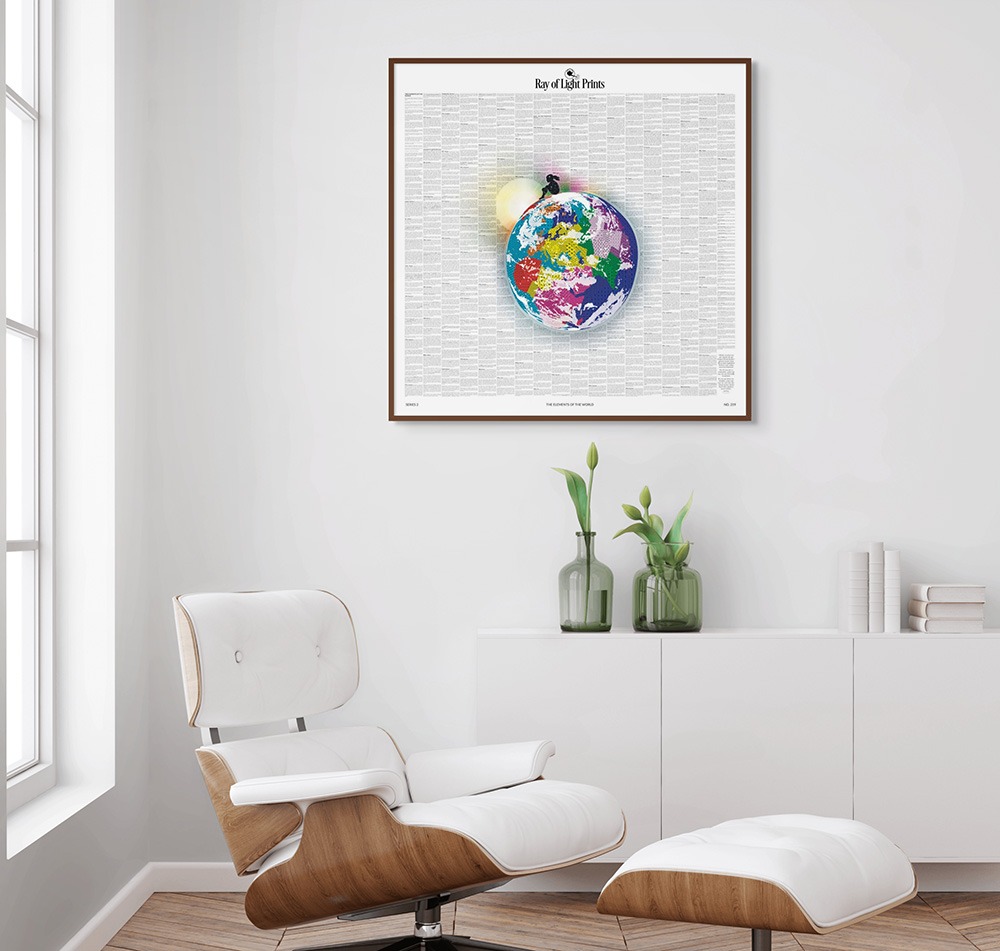
In our Elements of the World print, we took a similar approach. The periodic table isn’t just a chart; it’s a map of the building blocks of reality and our world, hence it’s represented as the world. The original table by Mendeleev was admired not just for its logic but for its elegance. Its structure helped people grasp what was previously invisible. That visual logic is part of what made it stick.
Beauty doesn’t just please the eye. It shapes how we think, feel, and learn. This is especially true when it comes to understanding complex information.
Neuroaesthetics, the study of how our brain responds to beauty, has shown that aesthetically pleasing visuals activate the brain’s default mode network, which is associated with self-reflection, meaning-making, and memory. Beauty makes things feel important. It captures attention and helps ideas land.
A study published in NeuroImage by Ishizu and Zeki (2011) found that when participants viewed something they found beautiful, whether it was music, art, or even a mathematical formula, their medial orbitofrontal cortex became active. That’s the part of the brain linked to reward and pleasure. It didn’t matter what kind of object they were seeing. The experience of beauty itself created engagement and emotional impact.
When we present information in a visually appealing way, the brain responds as if it were a reward. It draws us in. It makes us more curious, more focused, and more likely to remember.
This is why design matters so deeply in education and communication. It’s not just about making things look nice. It’s about making them resonate.

We live in a world that often feels messy and fast-moving. But when you hang a piece of art that tells a deeper story, rooted in knowledge, designed with intention, it changes how your space feels. And maybe even how you feel in it.
One customer told me she looks at our Human Body Systems print every morning while drinking her tea. “It reminds me that everything inside me is working together,” she said. “Even when I’m tired or stressed or feeling off, it’s all still happening. That gives me a kind of peace.”
That’s what beauty in science can do. It reminds us that we are part of something larger. That the universe, for all its chaos, has structure and grace and meaning.
At Ray of Light Prints, beauty isn’t an afterthought. It’s at the core of what we do. Because beauty doesn’t dilute science. It delivers it. It helps it land in the heart as well as the mind.
When something is beautiful, we look again. We care more. And in that extra moment of attention, learning becomes personal. Knowledge becomes part of you.
So yes, beauty in science matters. It matters deeply. And if our prints help even one person see that truth in a new way, then I know we’re on the right path.