
By Julia de Schultz, April 21, 2026

There is a strange thing that happens with the periodic table.
At school, it can seem like something far away from ordinary life. A chart on a classroom wall. A puzzle of symbols. A memory test. Hydrogen. Helium. Lithium. Carbon. Iron. Gold. A list to learn, then leave behind.
But the truth is, the periodic table never stayed in school.
It followed you home.
It is in the salt on your table and the copper in your walls. It is in the iron moving through your blood and the calcium holding up your bones. It is in the silicon inside your phone, the lithium in your battery, the gold in tiny connectors, the aluminium in your laptop case. It is in your kettle, your jewellery, your lightbulbs, your keys, your toothpaste, your pans, your plants, your breath.
The elements in everyday life are not hidden because they are rare. They are hidden because familiarity makes them invisible. We stop noticing what is always there.
And yet when you begin to see the world through the language of the elements, something shifts. The ordinary starts to glow a little. A kitchen becomes chemistry. A body becomes a living collaboration of atoms. A phone becomes not just a device, but a compact arrangement of Earth’s deep history, human ingenuity and ancient stardust.
This is one of the reasons the periodic table is so powerful. It is not just a scientific chart. It is a map of matter itself. A way of recognising that the same building blocks appear again and again, in different forms, at different scales, from stars to skin to circuitry.
Once you really feel that, the world does not look quite so ordinary anymore.
Everything material around us is made from elements.
Some things are made from a single element in relatively pure form, like the copper in electrical wiring or the aluminium in foil. Many others are compounds, combinations, or mixtures of elements working together. Water is hydrogen and oxygen. Salt is sodium and chlorine. Glass relies heavily on silicon in the form of silica. Steel combines iron with carbon and other elements. The objects around us may look separate, but underneath, they are variations on a shared set of ingredients.
That is what makes the periodic table so fascinating. It is at once simple and immense. A finite set of elemental building blocks, arranged by atomic structure, capable of giving rise to extraordinary variety.
Wood, ceramic, skin, batteries, jewellery, bone, plastic, blood, screens, soap, rain, stone. Different in texture, function and feeling, but all built from the same underlying alphabet of matter.
The point is not to memorise every element and where it appears. The point is to realise that matter is more intimate than it first seems. The world is not made of random disconnected things. It is made of patterns. Relationships. Repeated ingredients arranged in different ways.
And once you start noticing the elements in everyday life, you begin to see those relationships everywhere.

Your home is full of chemistry, though it rarely feels that way.
Take the kitchen. Something as simple as table salt already contains a story. Sodium is a highly reactive metal. Chlorine is a toxic gas. Yet together, in the right relationship, they become sodium chloride, one of the most familiar substances in the world. Something we sprinkle without thinking. Chemistry is full of transformations like that. Matter changing character through connection.
Then there is aluminium, light and versatile, showing up in foil, cookware, cans and frames. Copper runs quietly through wires behind walls, carrying electricity through the home with almost no fanfare. Iron appears in tools, fittings, appliances and pans. Carbon turns up in all kinds of forms, from wood and paper to plastics, fabrics and coatings. Silicon helps make glass possible, so even your windows hold a little piece of elemental logic.
Look around a living room and the chemistry keeps going. The pigments in paint. The metals in lamp fittings. The minerals in plaster and stone. The elements inside batteries, remotes, televisions and chargers. Even the houseplants are participating, drawing in carbon dioxide, taking in minerals through the soil, and turning sunlight into life.
A home can feel soft, warm and deeply human, but underneath it is still a choreography of elements.
There is something beautiful about that. The idea that warmth and meaning are not separate from matter, but carried through it. The same world that gave us mountains and stars also gave us ceramics, candleholders, copper kettles, bookshelves, glass vases and wooden tables. The home is not outside nature. It is one of the ways nature has been rearranged into shelter, ritual and daily life.

If chemistry in the home feels easy to forget, chemistry in the body is stranger still, because we do not think of ourselves as made of elements in the same way we think of objects.
We think of ourselves as living, feeling, conscious beings, which of course we are. But we are also material. And the body is one of the most extraordinary chemical arrangements on Earth.
Oxygen, hydrogen, carbon and nitrogen make up the bulk of the human body. These are joined by other vital elements that appear in smaller amounts but play enormous roles. Calcium gives strength to bones and teeth. Phosphorus helps form DNA, cell membranes and the energy systems that keep life moving. Iron allows red blood cells to carry oxygen around the body. Sodium and potassium help make nerve impulses possible. Iodine supports thyroid hormones. Zinc helps with repair, immunity and enzyme function.
None of these elements mean much on paper until you feel what they are actually doing.
Iron is not just a word on a chart. It is part of what lets oxygen travel through your bloodstream. Calcium is not just the white of a supplement tablet. It is structure. Support. A mineral architecture inside you. Phosphorus is not just another chemical term. It is part of the machinery of life itself.
The body is not only alive. It is coordinated. Intelligent. Relentlessly active. It takes these elements, absorbed through food, water and air, and turns them into movement, thought, heartbeat, memory, repair, sensation, growth. It builds tissues. Sends signals. Balances fluids. Heals wounds. Translates chemistry into experience.
This is one of the quiet miracles of being human. The same elemental world that gives us rock, metal and salt also gives rise to breathing, feeling and awareness.
There is humility in that, but also awe.
Because when we say that the body is made of elements, we are not reducing life. We are revealing one layer of its beauty. We are remembering that life is not separate from the universe. It is one of the forms the universe takes.

Technology can feel the furthest removed from nature.
Smooth screens, wireless signals, digital tools, invisible code. It is easy to imagine tech as something almost weightless, something purely virtual. But every device begins in matter. Every sleek object in your hand is a carefully assembled gathering of elements.
Silicon is one of the most famous examples. It sits at the heart of modern electronics, helping make computer chips possible. Copper carries electrical signals through circuits and cables. Gold appears in small amounts because it is such a reliable conductor and resists corrosion. Aluminium is valued for its lightness and strength. Lithium has become central to rechargeable batteries. Other elements, including cobalt, nickel and rare earth elements, also play important roles in the devices many of us use every day.
A smartphone, then, is not just a smart object. It is a compact geological story. Metals, minerals, conductors, semiconductors, carefully refined and arranged into something that can stream music, store photographs, send messages across continents and place the world’s knowledge in your palm.
That is astonishing when you stop to think about it.
And it also gives technology a different kind of weight. Not just physical weight, but philosophical weight. The digital world is not floating in nothingness. It is built from the Earth. From mined materials, transformed through labour, design and chemistry. The elegance of tech can make us forget its material origins, but those origins matter.
To notice the elements in our devices is not to make technology less magical. It is to understand its magic more honestly.
At one level, this article is about chemistry. But at another level, it is about perception.

Because once you start seeing the elements in everyday life, ordinary objects begin to feel less mute. You look at a window and think of silicon. You look at a spoon and think of metal drawn from the Earth. You look at your own hand and remember that inside it are minerals, salts, trace elements, electrical signals, water, carbon, structure, motion.
You begin to understand that everyday life is not separate from science. Science is simply one of the languages that helps us see what has always been here.
And that shift in perception matters.
It can make the world feel richer. More connected. More worthy of attention. It can turn the home from backdrop into wonder. It can turn the body from something we criticise into something we respect. It can turn technology from something we take for granted into something we see with greater curiosity and responsibility.
This is one of the deepest gifts of knowledge. It does not only give us information. It changes the texture of what we notice.
A tap becomes a chemistry lesson. A battery becomes a story of stored energy. Blood becomes an elemental river. A room becomes a gathering of transformed matter. The ordinary becomes less flat, not because it has changed, but because we have.
One of the most beautiful things about the elements is the way they dissolve artificial boundaries.
We are used to separating things into categories. Nature over here. Home over there. Body here. Technology there. But the elements quietly remind us that all of it belongs to the same material reality.
The copper in a wire, the iron in your blood, the calcium in your bones, the silicon in glass, the carbon in a book, the lithium in a battery. Different contexts, same deeper world.
This is part of what makes the periodic table feel almost poetic when you sit with it long enough. It shows that complexity does not erase kinship. The world branches into endless forms, yet underneath those forms, there is still continuity.
You are not outside the material universe, observing it from a distance. You are one expression of it.
So is your home. So is your phone. So is the table you rest your coffee on, the salt in your lunch, the lightbulb over your head, the jewellery on your wrist.
Seen this way, the periodic table is not cold or abstract. It is intimate. It brings us closer to the substance of life.
This is also one of the reasons educational art can be so powerful in the home.
A good piece of art does not only decorate. It changes what a room invites you to notice. It can place ideas, beauty and perspective into the spaces where life actually happens. On the wall by the dining table. In the hallway. In the office. Near the sofa. In the room where children ask questions. In the place where guests pause and look closer.
The periodic table, when treated with imagination, is not just educational content. It is a way of bringing the hidden structure of the world into daily view. A reminder that matter is more wondrous than it first appears. A reminder that the things we handle every day are part of a much bigger story.
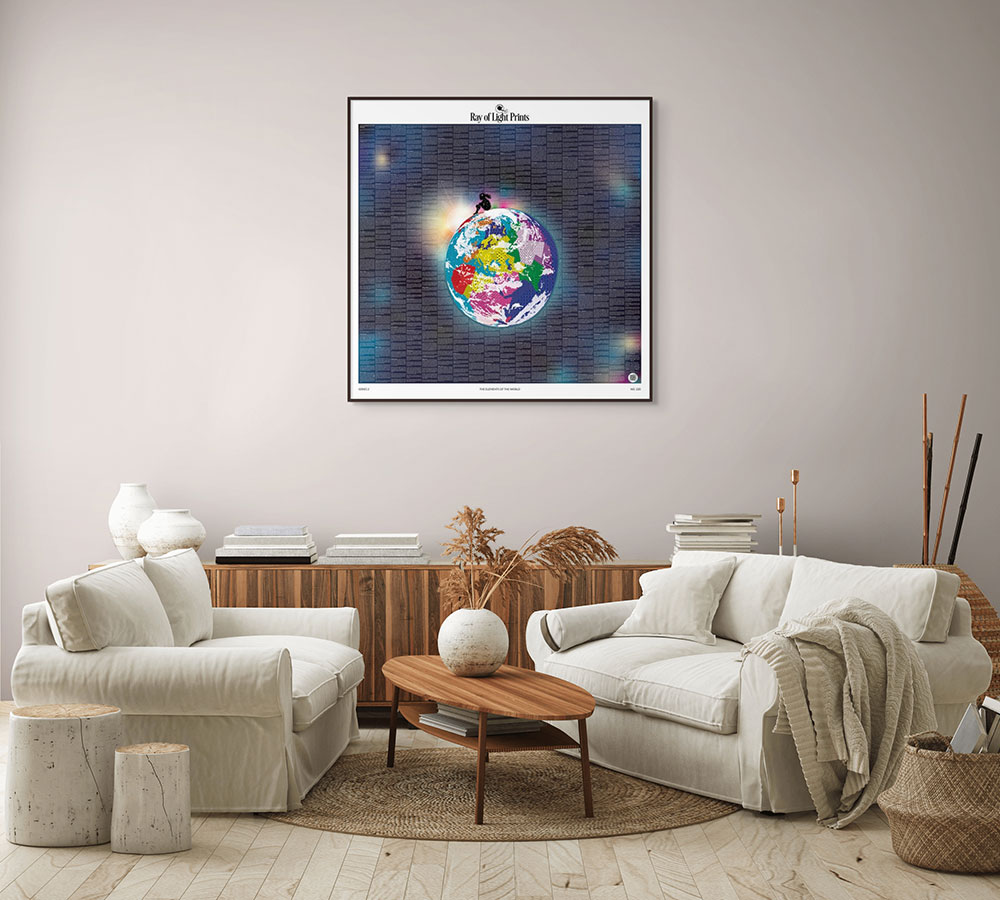
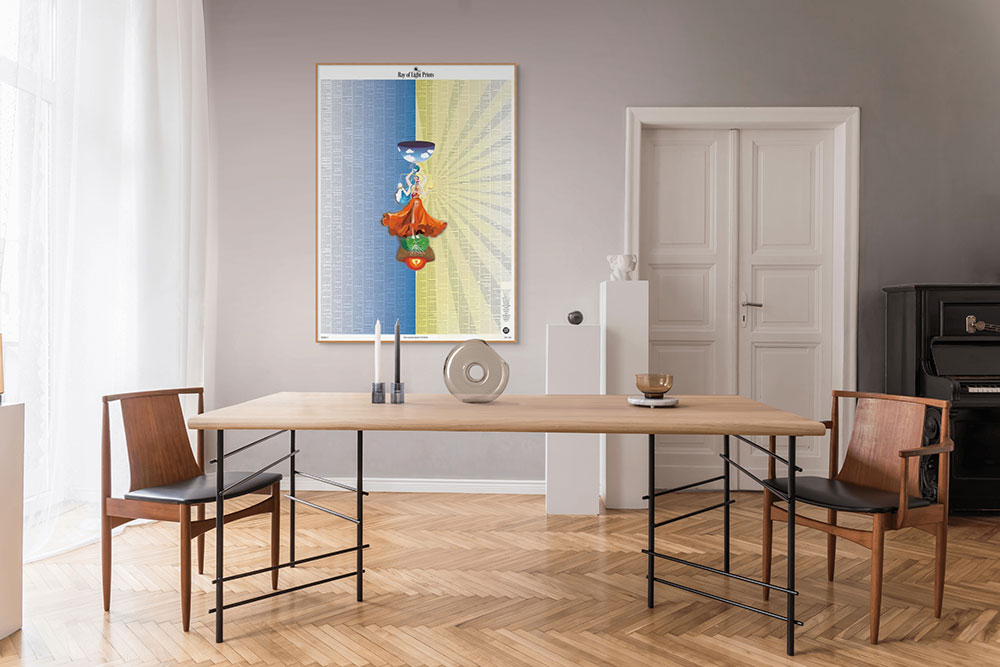
That is part of the thinking behind our Elements of the World print. It was created not simply to display information, but to help make the invisible visible. To take the chemistry hiding in plain sight and turn it into something beautiful enough to live with.
Because there is something powerful about being reminded, in the middle of ordinary life, that your world is made of extraordinary things.
The periodic table did not suddenly become relevant when you opened a textbook, and it did not stop being relevant when you closed one.
It has been in your home all along. In your blood. In your bones. In your wiring. In your screens. In your water. In your food. In the objects you use without a second thought.
The elements in everyday life are easy to miss precisely because they are so constant. But once you start noticing them, the world gains depth. A kind of hidden dimension. You see that the ordinary is not simple in the sense of being empty. It is simple only in the sense that it has become familiar.
Underneath that familiarity is wonder.
The same matter that helped shape stars, planets and oceans now helps form your kitchen, your body and the technology you carry in your pocket. Chemistry is not happening somewhere else. It is happening here, all the time, inside and around you.
And perhaps that is one of the most beautiful things the periodic table can teach us.
Not just what the world is made of.
But how astonishing it is that we get to live inside it.